

Background
AI this, AI that... What do students actually need to know about Artificial Intelligence? And what exactly are data skills good for? Answers can be found on this page.
AI Literacy
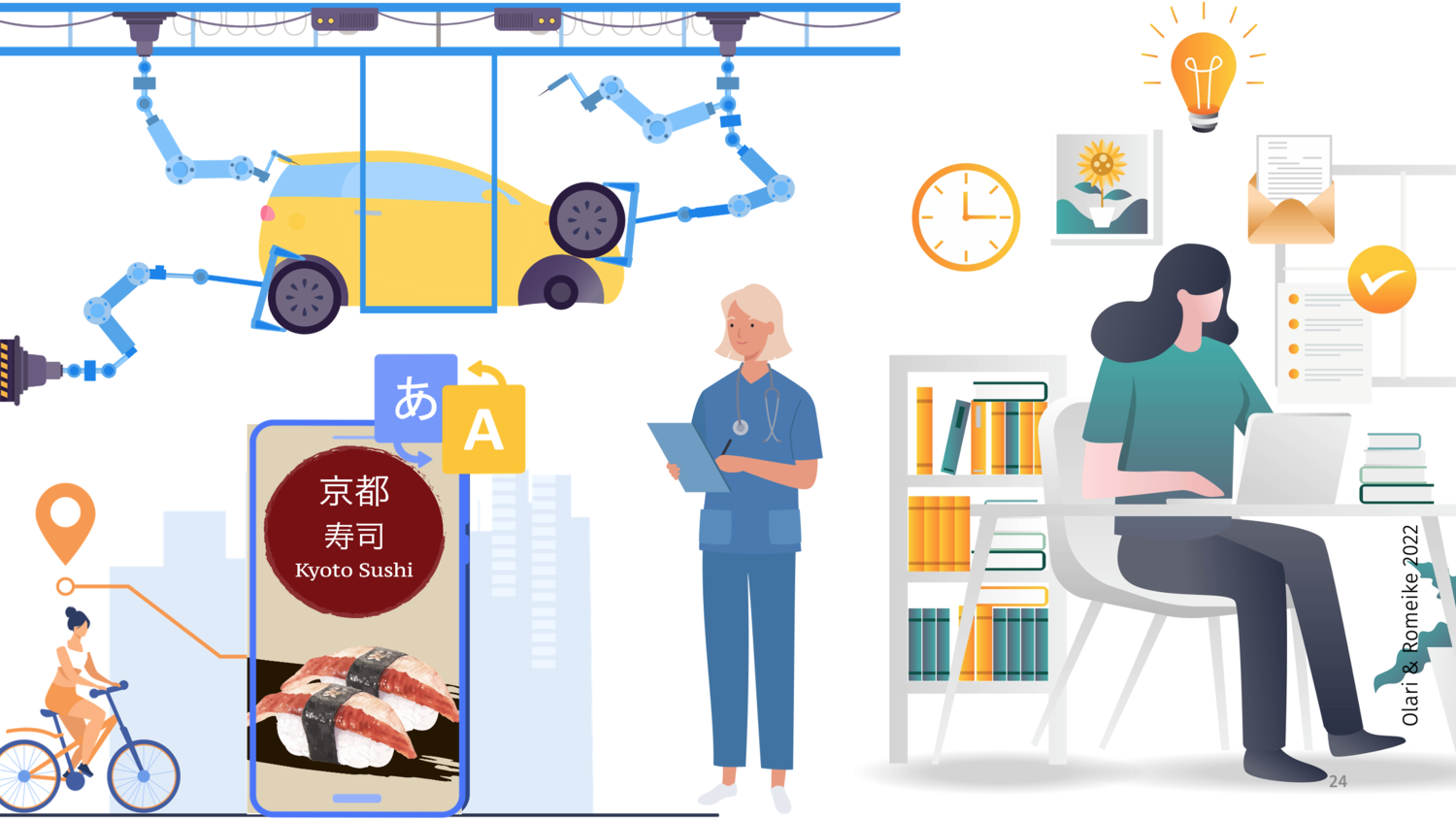
Young children oftentimes know much more about digital applications than adults – this is true even for tools based on Artificial Intelligence. Siri, Alexa, ChatGPT: students naturally use AI applications in their daily lives. Ensuring that this interaction doesn’t put them in precarious situations and enabling them to even use them effectively, means introducing AI competencies into curricula.
But what even are AI competencies? AI literacy is a set of competencies that enable individuals to:
>> understand and critically evaluate AI technologies;
>> communicate and collaborate effectively with AI;
>> and use AI as a tool online, at home, and in the workplace [1, 2].
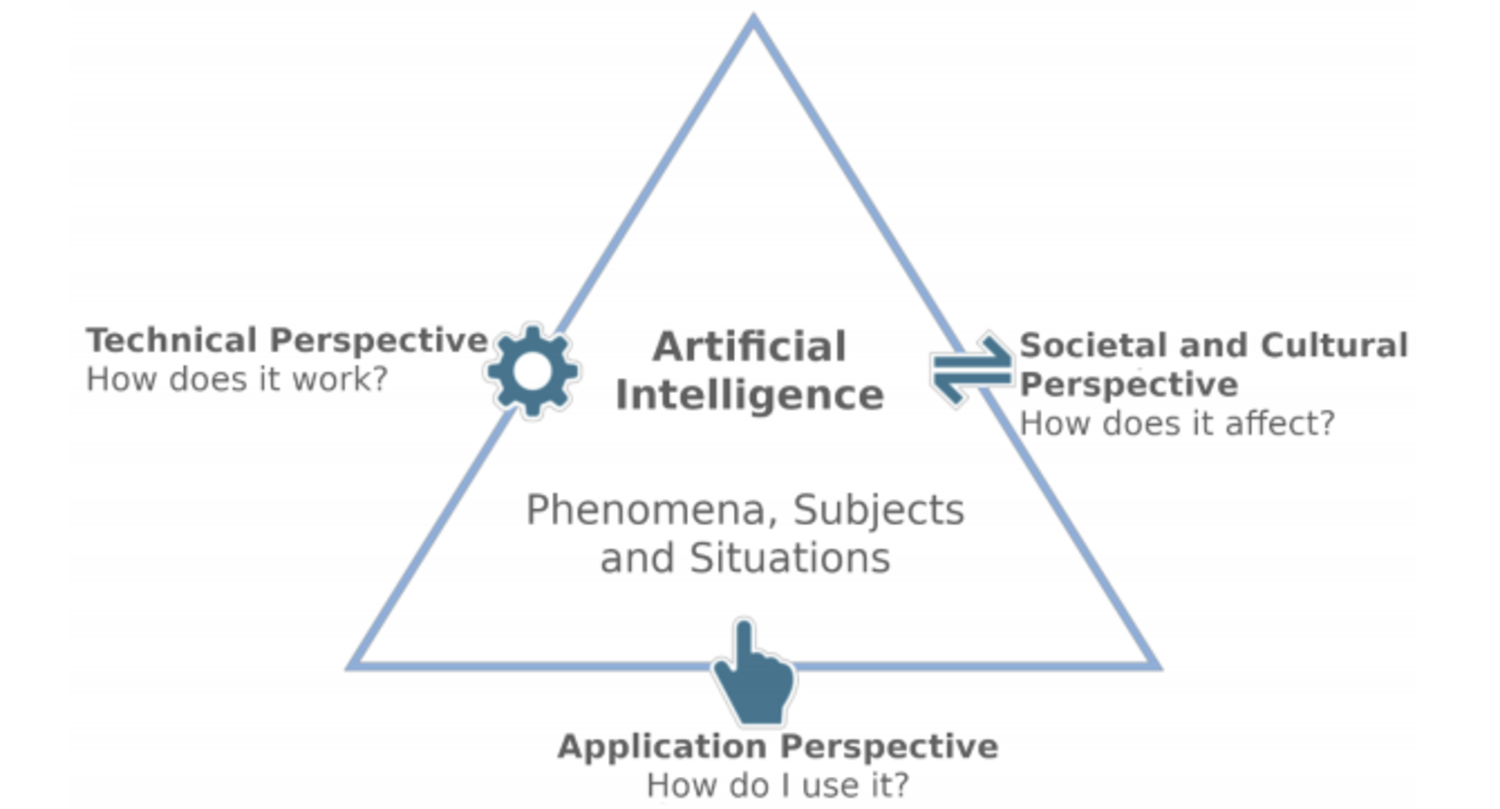
TrainDL relies on an initial effort made by project partners to capture the core aspects relevant to AI education: this adapts the “Dagstuhl-Dreieck” for defining the core aspects of the “Digital Networked World” to AI education. The picture on the right represents an adaptation to the AI context of the “Dagstuhl-Dreieck” for digital education, in which AI education is categorized by three core aspects:
>> the technical perspective,
>> the societal and cultural perspective,
>> and the application perspective.
Some specific areas that can be identified for those three categories are, for example:
>> Identification of AI systems, definition of AI and strong vs. weak AI
>> Bias, security and reliability of AI as well as impacts, chances and challenges of AI
>> Error-proneness of AI and use-case-specific selection of AI methods
According to this concept, in the TrainDL workshops, teachers not only learn to show their students what AI concepts are but also teach them where and how AI-based applications can be of use and how to evaluate and challenge them critically.
Data Literacy
Data is all around us: especially when we navigate the internet – something that is a crucial part of students’ lives nowadays. How do they secure their private data? What does it mean to analyze and evaluate data? How can they use data to learn more efficiently or safely improve their work? Teaching students in the sphere of data entails answering a lot of questions.
But what does it even mean to become data “literate”? Data Literacy can be defined as ”the ability to collect, manage, evaluate, and apply data in a critical manner” [3].
The most standard definition of data literacy in education is provided by the EU digital competence framework (DigComp). As one of its 5 competence areas, it categorizes the “Competence area 1: Information and data literacy”. Information and data literacy is defined by competencies in:
>> browsing, searching, filtering data, information and digital content;
>> evaluating data, information and digital content;
>> managing data, information and digital content.
This is the understanding of data literacy that serves as a basis for the work in the TrainDL project. According to DigComp, examples of addressed competencies in learning materials could be to enable students to:
>> explain their information needs,
>> search data, information and content in digital environments,
>> explain how to access them and navigate between them,
>> analyze, compare and evaluate the credibility and reliability of sources of data, information and digital content,
>> analyze, interpret and evaluate data, information and digital content,
>> select data, information and content and
>> organize them in a routine way in a structured environment.
To dive deeper into the theoretical background of the project, read on in:
>> D1.1 - Policy Research Summary and D5.1 - Research of policies/curricula
[1] Duri Long and Brian Magerko. 2020. What is AI Literacy? Competencies and Design Considerations. Proceedings of the 2020 CHI Conference on Human Factors in Computing Systems, 1–16. https://doi.org/10.1145/3313831.3376727 [Online; accessed 2023-01-31].
[2] Tilman Michaeli, Ralf Romeike, and Stefan Seegerer. 2023. What Students Can Learn About Artificial Intelligence - Recommendations for K-12 Computing Education. In Towards a Collaborative Society Through Creative Learning, Therese Keane, Cathy Lewin, Torsten Brinda, and Rosa Bottino (Eds.). Springer Nature Switzerland, Cham, 196–208. https://doi.org/10.1007/978-3-031-43393-1_19
[3] Chantel Ridsdale, James Rothwell, Mike Smit, Michael Bliemel, Dean Irvine, Dan Kelley, Stan Matwin, Brad Wuetherick, and Hossam Ali-Hassan. 2015. Strategies and Best Practices for Data Literacy Education Knowledge Synthesis Report. https://doi.org/10.13140/RG.2.1.1922.5044
[4] UNESCO. 2021. Beijing Consensus on Artificial Intelligence and Education. (Jul 2021). https://unesdoc.unesco.org/ark:/48223/pf0000368303